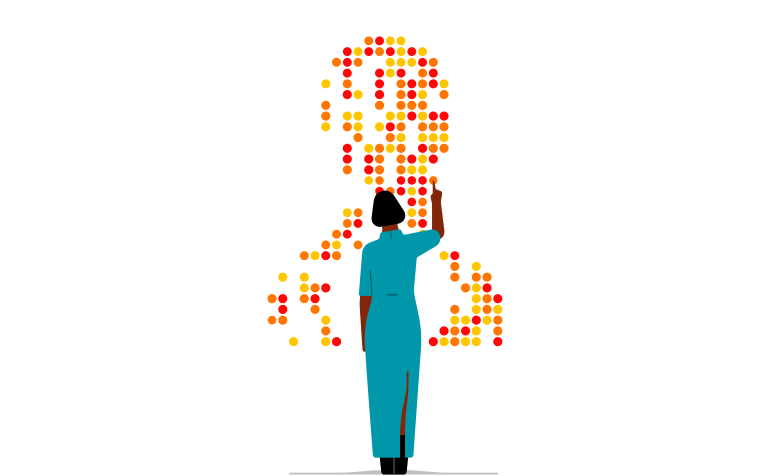
Insurance underwriting has been stuck in the same cycle for decades—necessary but slow, thorough but frustrating. By 2030, that changes completely. Underwriting becomes the engine that drives growth, not the brake that slows it down.
The shift won't happen overnight, and it won't look the same everywhere. Technology, regulation, and what consumers actually want will push the industry down three very different paths.But here's what every successful company will have in common: they'll deliver speed, build trust, and give people the clarity they need to make decisions right when they're ready to buy.

Scenario 1

The Augmented Expert
When Humans and AI Work Together
This future strikes a balance. Regulators have embraced AI innovation while keeping strong consumer protections in place. The result? Underwriters become conductors of an AI orchestra, handling the complex stuff while machines take care of routine decisions.
The technology behind it: Advanced systems that protect privacy while learning from massive datasets, natural language processing that reads documents instantly, and smart contracts that handle policy changes automatically.
What it looks like
day-to-day
- Underwriters manage thousands of policies, with AI flagging what needs human attention
- Customers get wellness tips and premium adjustments based on how they actually live their lives
- Real-time health data informs pricing, but humans still make the final call on complex cases
- Policies adapt continuously — your coverage evolves as your life does
Scenario 2

The Automated Marketplace
AI Takes the Wheel
In this scenario, automation dominates. Consumers demand speed and low cost, pushing companies to let algorithms make nearly all underwriting decisions with little to no human involvement.
The technology behind it: End-to-end AI platforms, real-time data integration from IoT and wearables, and fully automated claims and policy adjustments.
What it looks like
day-to-day
- AI handles underwriting start to finish, with regulators setting clear guardrails
- Policies are priced dynamically and updated instantly as customer data changes
- Human underwriters are rare—reserved for appeals or edge cases
- Insurance feels like streaming subscriptions—fast, flexible, and personalized
Scenario 3
The Regulated Hybrid
Striking a Careful Balance
Regulators restrict full automation, requiring human judgment for many underwriting decisions. Companies must blend technology with traditional expertise to stay competitive.
The technology behind it: Hybrid systems that combine rule-based compliance with flexible AI tools, allowing insurers to switch between automation and human-led decisions as needed.
What it looks like
day-to-day
- Some products are fully automated, while others require human sign-off
- Customers experience a mix of instant decisions and traditional wait times
- Insurers compete on flexibility—who can pivot faster between AI and human processes
- Compliance costs rise, but trust and transparency improve
What This Means for Everyone
Each future creates different winners:
In the Augmented Expert world,
companies that master human-AI collaboration dominate. Success comes from having people who can work with machines, not replace them.
The Automated Marketplace
rewards tech-savvy insurers with scalable platforms. If you can’t build and maintain sophisticated algorithms, you can’t compete.
The Regulated Hybrid future
favors companies that can operate flexibly. You need both cutting-edge automated systems and traditional human expertise—and the ability to switch between them seamlessly.
But across all three scenarios, the winners share common traits: adaptable technology, strong data practices, robust compliance, and a culture of continuous innovation.
Getting Ready for Whatever Comes
Smart companies prepare for multiple futures:

Build flexible technology.
Your systems need to work whether regulations tighten or loosen, whether customers want full automation or human touch.

Invest in people.
Train underwriters in both traditional risk assessment and new technologies. The future belongs to humans who can work with AI, not humans who get replaced by it.

Shape the conversation.
Work with regulators now to influence how these changes unfold. Don't just react to new rules—help create them.
How Zinnia Fits In?
We're building the infrastructure that works in any of these futures. Our platforms adapt whether underwriting becomes more automated, more human-centered, or splits down the middle.
The common thread? Underwriting stops being a bottleneckand becomes a competitive advantage. Speed, trust, and clarity at the moment someone decides to buy—that's what drivesgrowth in 2030.
Contact us to talk about how we can help you shape the UW future.

Shape your underwriting for 2030 — discover what's possible.
Harsh Chowdhary
Head, Underwriting Solutions & Services